Irish School Uniform Cost Calculator
Estimate the cost of school uniforms in Ireland based on your child's school level and optional items. Costs are based on 2024 averages from the article.
Estimated Uniform Cost
Note: Costs are estimates based on 2024 data. Many schools offer second-hand uniform exchanges and free packs through organizations like St. Vincent de Paul. Gender-neutral options are increasingly available.
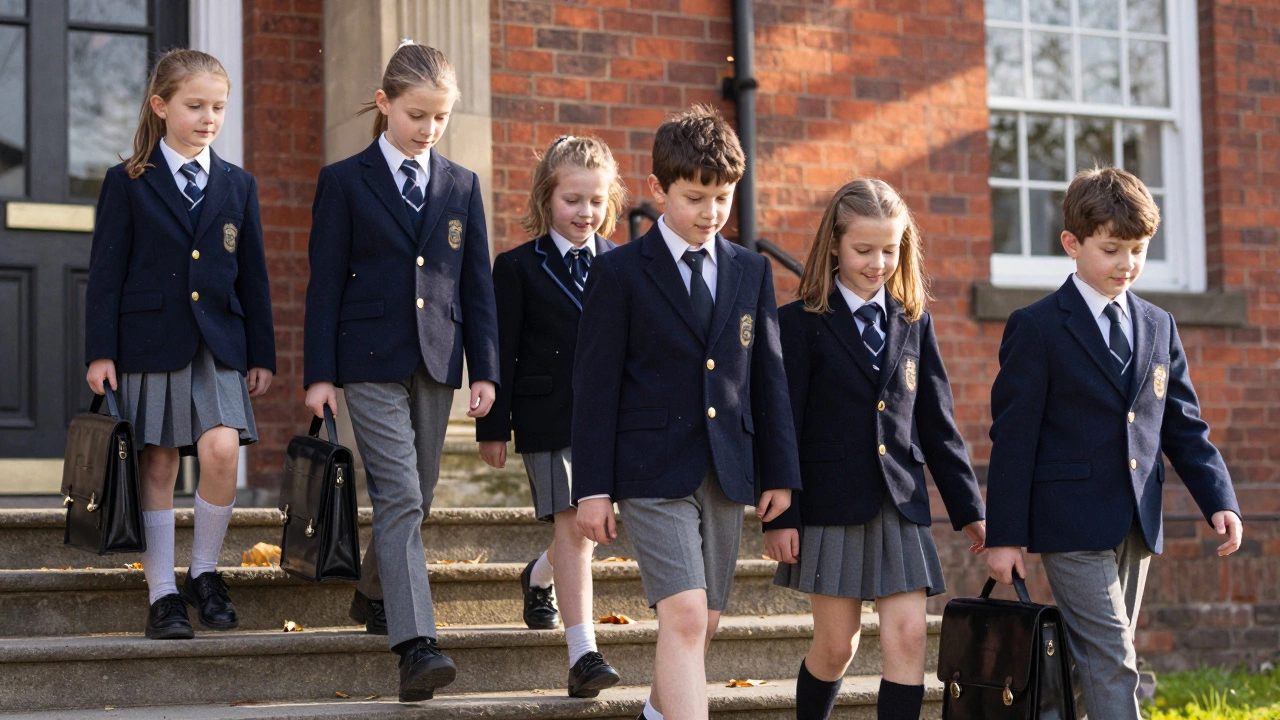
When you see a row of children in navy blazers and grey trousers walking into a primary school in Bray or a secondary school in Limerick, it’s easy to assume uniforms have always been part of Irish life. But who actually created uniforms? And how did they become so deeply woven into the fabric of education in Ireland?
The Origins of School Uniforms: Not Irish, But Imported
School uniforms didn’t start in Ireland. They began in England - specifically at Christ’s Hospital in London, founded in 1552. This charity school for orphaned children gave students a standardized outfit: long blue coats, yellow socks, and brass buttons. It wasn’t about discipline or conformity at first - it was about dignity. These children had nothing. The uniform gave them identity, pride, and a sense of belonging.
By the 1700s, elite British schools like Eton and Harrow had adopted similar styles. When Irish education systems began to formalize under British rule, these uniform traditions came with them. The first Irish schools to adopt uniforms were the Church of Ireland and Catholic grammar schools in Dublin, Cork, and Galway - places where class and religion shaped access to learning. Uniforms weren’t just clothing; they were markers of status and piety.
How Uniforms Took Root in Irish Classrooms
By the late 1800s, as Ireland’s national school system expanded under the British-run Board of Education, uniforms became more widespread - especially in urban areas. Rural schools often couldn’t afford them. A child in Donegal might wear their best coat and cap, while a child in Kilkenny wore a matching blazer and tie. The difference wasn’t just geography - it was economics.
The 1922 formation of the Irish Free State didn’t end the trend. Instead, it deepened it. The Catholic Church, which ran most schools, saw uniforms as tools of discipline and moral order. They removed visible class markers - no more patched trousers or mismatched shoes. In places like St. Mary’s in Clonmel or St. Patrick’s in Thurles, uniforms became symbols of communal identity. You weren’t just a student - you were part of a community that wore the same thing.
Even today, you can still find the old blue-and-gold blazers from the 1950s in school archives in Waterford and Drogheda. Some schools still use the same supplier: McGee’s Tailors in Limerick, established in 1923, still makes blazers for over 40 Irish schools. Their signature button - a stylized harp with the school crest - hasn’t changed in 70 years.

Why Uniforms Stayed: More Than Just Rules
It’s not just tradition. In Ireland, uniforms serve practical purposes too.
- Reduced pressure on families: In a country where 1 in 5 children live at risk of poverty (according to the Central Statistics Office, 2024), uniforms level the playing field. A child in Galway doesn’t need designer sneakers - just a pair of black school shoes from Clery’s or Boots Ireland.
- Stronger school identity: From the green-and-gold stripes of St. Mary’s in Skerries to the maroon and cream of St. Joseph’s in Louth, school colours are tied to local pride. Parents often buy uniform items from local shops - like St. Kevin’s Uniforms in Blackrock - because they know the quality and support community businesses.
- Discipline and safety: After the 2018 Dublin school stabbing incident, many schools reviewed their uniform policies. Clear, standardized dress made it easier for staff to spot outsiders on campus. It wasn’t about control - it was about safety.
Even in schools that don’t require full uniforms - like some non-denominational schools in Dublin 15 or Cork 8 - many still enforce a dress code: no hoodies, no ripped jeans, no logos. It’s not about fashion. It’s about focus.
The Changing Face of Irish School Uniforms
But times are changing. In 2023, the Irish Primary Principals’ Network surveyed 320 schools. Over 60% reported requests from parents to allow more flexibility: girls wearing trousers instead of skirts, non-gendered blazers, and inclusive options for transgender students.
Some schools have adapted. St. Anne’s in Limerick now offers a “uniform choice” policy: girls can pick between a skirt, jumper, or trousers. In Belfast Road Primary in Derry (just over the border, but with strong Irish ties), uniforms are now made from sustainable cotton - a shift driven by parents who shop at Irish Wool Co. and support ethical brands.
Even the traditional navy blazer is evolving. New suppliers like Uniforms for All in Galway offer gender-neutral cuts and moisture-wicking fabrics - a nod to Ireland’s unpredictable weather. No more soggy wool on a rainy Tuesday in Sligo.

What’s Next for Uniforms in Ireland?
The debate isn’t about removing uniforms - it’s about modernizing them. The Irish public doesn’t want to abandon tradition. But they do want uniforms to reflect today’s values: inclusion, sustainability, and practicality.
Some schools are experimenting. In Kerry, a pilot program lets students choose from a range of approved colours for jumpers - as long as they wear the school badge. In Dublin’s inner city, some schools have partnered with St. Vincent de Paul to provide free uniform packs, complete with shoes and socks.
And while no single person “created” school uniforms in Ireland, the real story is this: it was never about one designer, one school, or one law. It was about generations of parents, teachers, and communities deciding - quietly, consistently - that wearing the same thing made their children feel like they belonged.
Why This Matters Today
If you’re a parent in Cork, a teacher in Galway, or a student in Wexford, the uniform you wear isn’t just fabric. It’s history. It’s community. It’s the quiet promise that no matter where you come from, you’ll be treated the same.
So who created uniforms? Not one person. But thousands - across towns, parishes, and classrooms - who believed that a simple outfit could do something powerful: make every child feel like they were part of something bigger.
Are school uniforms mandatory in all Irish schools?
No. While most primary and secondary schools in Ireland require uniforms, it’s not a legal requirement. Each school sets its own policy, usually decided by the Board of Management. Some schools - particularly non-denominational or multi-cultural schools - have relaxed rules or no uniform at all. However, over 85% of schools still enforce some form of uniform policy.
Can parents buy school uniforms online in Ireland?
Yes. Many schools now partner with online retailers like Uniforms for All (Galway), Irish Schoolwear (Dublin), and Clery’s online store. These sites offer delivery across the country, including rural areas in Donegal and Kerry. Some even have size guides tailored to Irish children’s average measurements - which are different from UK or US sizing.
Do Irish school uniforms include gender-neutral options?
Increasingly, yes. Since 2020, over 120 Irish schools have introduced gender-neutral uniform policies. Common changes include allowing girls to wear trousers, offering unisex jumpers, and removing gendered colour codes (e.g., blue for boys, pink for girls). Schools like St. Mary’s in Limerick and St. Joseph’s in Cork now list all uniform items as unisex on their websites.
How much do school uniforms cost in Ireland?
The average cost for a full primary school uniform is between €100 and €180. For secondary schools, it’s €150-€250, depending on whether blazers, ties, and PE kits are required. Many schools offer second-hand uniform sales or exchange programs. The St. Vincent de Paul Society also provides free uniform packs to eligible families - no application needed in some areas.
Why do some Irish schools still use the same uniform suppliers for decades?
It’s about trust and consistency. Suppliers like McGee’s Tailors in Limerick and O’Neill’s Schoolwear in Waterford have built relationships with schools over generations. Parents know the quality. Teachers know the fit. And the school badge - often hand-sewn - becomes part of the community’s identity. Changing suppliers isn’t just a logistical decision - it’s a cultural one.